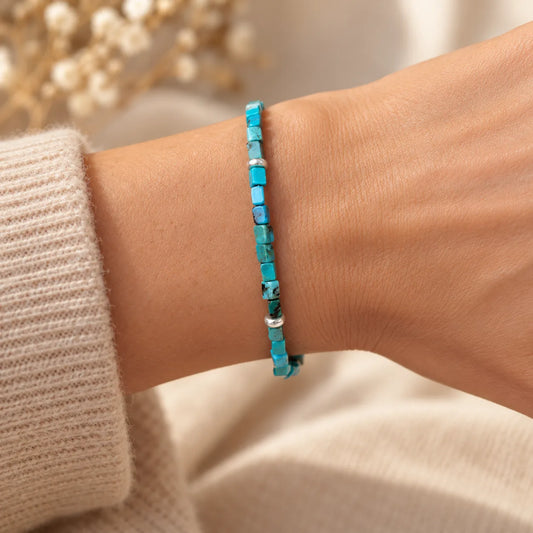
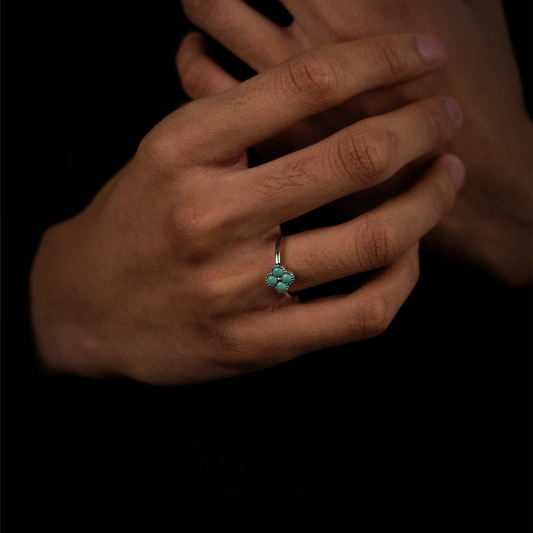
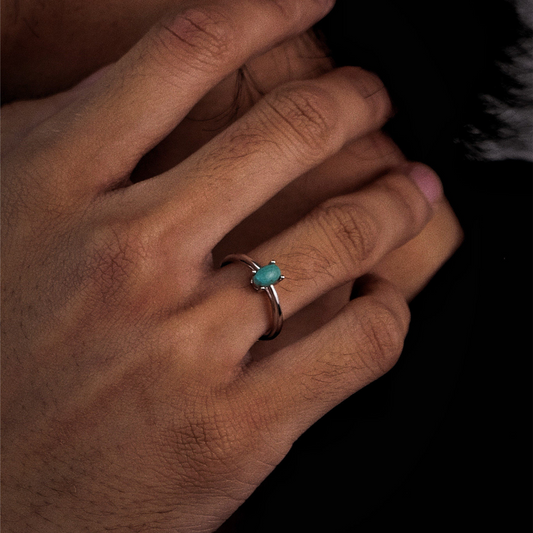
A genuine turquoise specimen is turquoise formed as a natural mineral, while an imitation is another material made to resemble it. Stabilized turquoise is a separate category: it may be natural turquoise that has been treated to improve durability. A stone’s material identity can inform its price, care, and the personal meaning you attach to it, but neither real turquoise nor imitation material can be assumed to create a medical or supernatural effect.
The most useful question is therefore not “Which stone has more power?” It is “What material am I actually buying, what can I verify, and does that material fit the meaning I want the jewelry to carry?”
1. What “Real,” “Natural,” and “Untreated” Actually Mean
These terms are often used as if they were interchangeable, but they answer different questions.
- Real or genuine turquoise: turquoise material is present rather than only a look-alike material.
- Natural turquoise: the turquoise occurs as a natural mineral. This does not, by itself, prove that the stone is untreated.
- Stabilized turquoise: natural turquoise may be treated with a substance to improve hardness, durability, or handling. The exact treatment should be disclosed by the seller.
- Reconstituted or composite material: fragments or powder may be bonded, or a composite may be manufactured to resemble a solid stone. The seller should identify the material accurately.
- Imitation: another material is used to copy turquoise’s appearance. Color alone does not make it turquoise.
This distinction matters because “genuine” is not a synonym for “untreated,” and “natural” is not proof of a particular mine, region, or spiritual outcome.
2. Real Turquoise vs Imitation: What Buyers Can Observe
Color, matrix, surface texture, weight, and price can help you ask better questions. They are not, by themselves, a complete authentication method.
| Observation | What it may suggest | What it cannot prove |
|---|---|---|
| Color variation | Natural turquoise can range from blue to green and can show variation between pieces. | Color does not confirm authenticity. Dyed or manufactured materials can also be colorful. |
| Matrix or host-rock pattern | Visible matrix can be part of a natural turquoise specimen. | Matrix is not a certificate. Imitations can be patterned to resemble it, and not all genuine turquoise has visible matrix. |
| Uniform surface | Very even color or repeated pattern may justify asking about treatment or imitation. | Uniformity alone does not identify the material. Some genuine stones are more even than others. |
| Seller description | Specific material, treatment, care, and origin information is more useful than vague words such as “rare” or “pure.” | A description is not independent laboratory confirmation. Check whether the seller can support the claim. |
| Price | An unusually low price can be a reason to ask whether the stone is treated, composite, or imitation. | Price cannot authenticate a stone. High price is not proof of quality or origin either. |

3. What Realness Can Mean in Symbolic Jewelry
For some wearers, a natural stone’s visible variation and geological history make it feel more personal. The meaning may come from the object’s material story, the care taken in choosing it, and the ritual of wearing it—not from a proven ability to change health, energy, luck, or other outcomes.
An imitation can still be aesthetically pleasing or personally meaningful. The important ethical difference is whether it is clearly sold as an imitation or accurately described as another material. If authenticity is part of the wearer’s intention, undisclosed imitation can weaken trust in the piece.
A ring may serve as a tactile reminder when you notice it on your hand. A necklace may mark a personal intention through placement near the chest or throat. A bracelet may become part of a daily routine through its movement on the wrist. These are personal associations, not guaranteed properties of the stone.
For a practical sensory exercise that does not make treatment claims, read our gentle sensory grounding ritual guide.
4. Stabilized, Dyed, and Reconstituted Turquoise
Treatment is not automatically a reason to reject a stone. It is a reason to understand what was done, why it was done, and whether it changes care, durability, appearance, or value.
Stabilized turquoise may begin as natural turquoise but be treated to make a softer or more porous material more suitable for jewelry. Dyed material has been colored. Reconstituted or composite material may contain fragments, powder, binder, or other components. Imitation turquoise uses a different material to copy the look.
Material disclosure is the trust test
Before buying, look for a description that answers the questions a reasonable buyer would have:
- What is the stone? Turquoise, stabilized turquoise, dyed material, composite, or imitation?
- What is the treatment? If the stone is treated, is the treatment named clearly?
- What care does it need? Are water, perfume, heat, and chemicals addressed?
- What is confirmed? Is the seller making a material claim, or an unsupported claim about mine, altitude, origin, or spiritual effect?
The FTC Jewelry Guides explain that gemstone descriptions should accurately represent characteristics including treatment and origin. For gemological background, see the GIA turquoise overview.

5. What You Can Check at Home—and What You Cannot
At home, you can inspect photos, ask for material disclosure, compare color and pattern consistency, and check whether the care instructions match the material described. These steps improve buying judgment but do not replace professional testing.
Avoid treating a scratch test, water test, touch test, or color test as definitive. Some tests can damage a stone or its finish, and many look-alike materials can produce misleading results. When the purchase is valuable, disputed, or represented with a strong origin claim, ask an independent gemologist or gemological laboratory what examination is appropriate.
6. A Practical Buying Checklist
- Read the material name carefully. Do not treat “blue stone,” “natural-looking,” or “inspired by turquoise” as proof that the stone is turquoise.
- Look for treatment disclosure, especially when treatment may affect care, durability, or value.
- Ask for close-up images in natural-looking light and compare the stone with its stated material.
- Treat origin claims as claims that require documentation. A color pattern cannot prove a mine or geographic source.
- Check sizing, setting, metal, care, and return terms—not only the symbolic story.
- For a high-value purchase, obtain independent professional testing rather than relying on a home test or seller assurance alone.
Choose a tactile piece for your own meaning
If you want jewelry to function as a personal reminder, choose the form you will actually notice and wear. Review the individual product description for the material and care details before purchasing.
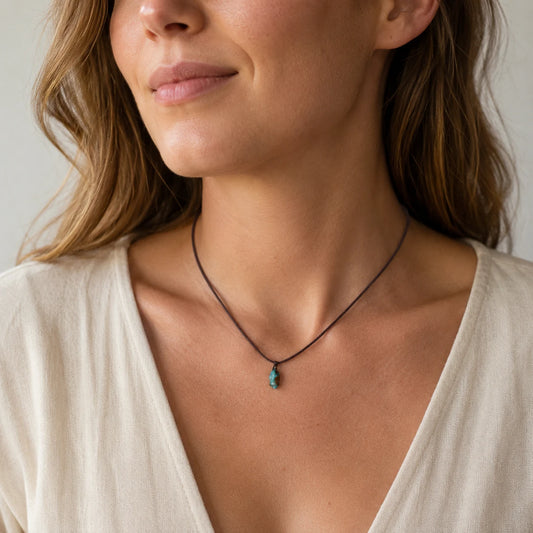
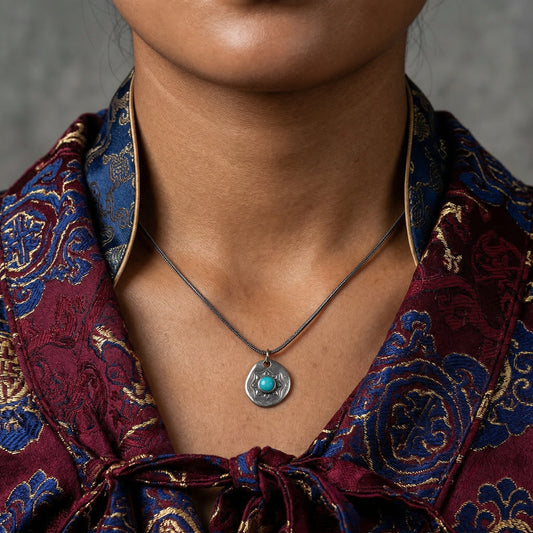
A pendant can keep a personal symbol close to the body while remaining easy to style.
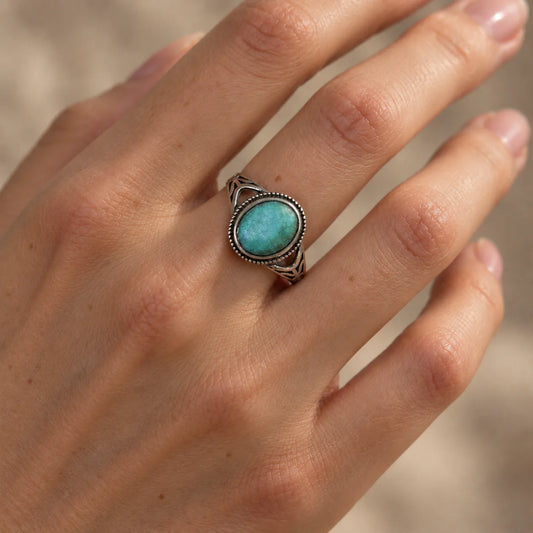
View Shield NecklaceA ring is easy to notice during ordinary hand movement, making it suitable for a quiet personal reminder.
View Stillness RingA bracelet adds movement and texture without requiring a separate ritual or occasion.
View Clear Sky Bracelet
7. FAQ: Real Turquoise, Imitation, and Meaning
Does fake turquoise have the same meaning as real turquoise?
Answer: Meaning is personal, so an imitation can still be meaningful to its wearer. It does not have the same material history as natural turquoise. If authenticity is part of your intention, accurate disclosure matters more than a dramatic spiritual promise.
Does stabilized turquoise count as real turquoise?
Answer: Stabilized turquoise may contain natural turquoise that has been treated. It should be described accurately as stabilized rather than automatically presented as untreated. Check the seller’s material and treatment disclosure.
Can matrix prove that turquoise is genuine?
Answer: No. Matrix can be a natural feature, but pattern alone cannot authenticate a stone. A professional examination may be needed when the material or value is disputed. For a broader checklist, read how to identify real turquoise.
Can turquoise protect me or treat anxiety?
Answer: There is no basis here to promise a medical or supernatural effect. You can use jewelry as a personal reminder, sensory object, or style choice, but it should not replace medical or mental-health care.
Continue with practical turquoise guides
Use this article for the distinction between material facts and personal meaning. Then use the supporting guides for specific buying questions.
Review practical observations and their limitations before buying.
Read how to identify real turquoiseLearn why dyed howlite can resemble turquoise and why a home test is not definitive.
Read dyed howlite vs turquoiseUnderstand care requirements and why material, treatment, workmanship, and disclosure affect value.
Read the turquoise care guideConclusion: Let the Material Story Be Clear
Real turquoise, treated turquoise, and imitation turquoise can all be attractive. The responsible distinction is not whether one object guarantees a spiritual result. It is whether the material is represented honestly, whether the treatment and care are clear, and whether the piece fits the personal meaning you want it to carry.
Choose the stone because you understand what it is. Let its color, texture, setting, and daily use support your own ritual or style without asking the jewelry to make promises it cannot prove.
Sources and fact boundary
This article uses the GIA overview of turquoise and the U.S. Federal Trade Commission’s Jewelry Guides for general information about turquoise, imitation materials, treatment disclosure, and accurate product descriptions. Personal symbolism and sensory experience are presented as individual interpretation, not as gemological or medical facts.