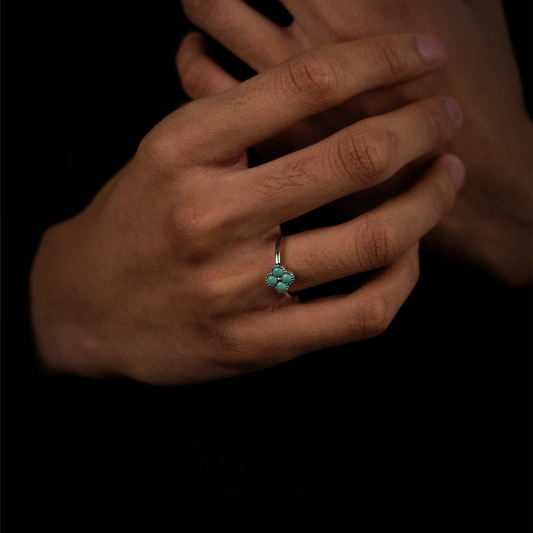
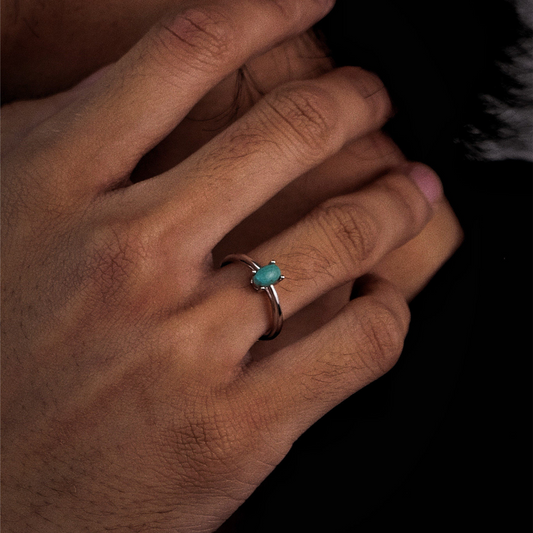
A minimalist wardrobe makes getting dressed easier — until you reach for jewelry. I used to overstack my wrist until I noticed it was the only thing people registered in a meeting. Add one wrong piece and a quiet outfit starts to look busy; add nothing and the whole look can feel unfinished. If your closet lives in black, grey, cream, and denim, the question is rarely whether to wear jewelry. It is how to layer a few pieces so they read as intentional, not accidental.
To layer minimalist jewelry, start with one anchor piece, allow yourself a single color moment, stack by body zone instead of by quantity, stay inside one metal family, and let natural stone texture do the decorating for you. Follow those five rules and even a bold-matrix turquoise piece will sit comfortably inside a neutral wardrobe.
Before we get into the rules, one honest note: layering only works when the pieces themselves are worth looking at up close. If you have not bought your first stone piece yet, it helps to read how to identify real turquoise first, so the piece you build your stack around is material you can trust.
Build the stack on paper before you buy
If you came here with a cart full of "maybe," pause in planning mode for a moment. A minimalist stack is designed backwards: decide the role of each zone — neck, wrist, hand — before deciding which product fills it.
Pick your anchor zone. The place people's eyes land first: usually the neckline for crew-neck and knit outfits, the hand if you talk with your hands all day.
Count your color moments. In a neutral wardrobe, one is usually enough. Turquoise is a strong single color moment; it rarely needs company.
Check your metals. Look at what you already own. If most of it is silver-toned, stay there. Consistency is what makes three pieces read as one decision.
1. Start With One Anchor Piece
Every minimalist stack has a hierarchy. One piece is the sentence; everything else is punctuation. The anchor is usually the piece with the most visual weight — a framed stone pendant, a signet ring — and it should be the first thing you put on, not the last.
A practical test: put on only the anchor and look in the mirror. If the outfit already feels finished, everything you add afterwards is optional, which is exactly the position you want to be choosing from.

2. Keep Just One Color Moment Per Outfit
Minimalist does not mean colorless. It means color is rationed. A single turquoise stone against grey knitwear or a white shirt does more work than five delicate gold chains, because it is the only place color happens.
This is also where stone quality quietly matters. A naturally varied blue-green with visible depth reads as a considered choice; a flat, uniform, plastic-bright blue reads as costume. If a very cheap stone looks suspiciously even in color, compare it against our guide to dyed howlite vs turquoise before letting it into a restrained wardrobe — imitation material is often loudest in exactly the way minimalism can't absorb.

3. Stack by Zone, Not by Quantity
The most common layering mistake is counting pieces ("is three too many?") instead of counting zones. The body has three natural jewelry zones — neck, wrist, hand — and a minimalist stack gives each zone at most one focal point.
Three pieces across three zones looks composed. Three pieces crowded onto one wrist looks like a drawer emptied itself. Use the cheat sheet below as a starting grid:
| Outfit / neckline | Neck | Wrist | Hand |
|---|---|---|---|
| Crew-neck tee or knit | Short geometric pendant | Bare, or one structured bracelet | One signet-style ring |
| Open collar / V-neck shirt | Pendant sitting just above the neckline | Watch or bracelet, not both | Bare, or one slim band |
| Office blazer over a blouse | Framed pendant sitting just above the blouse collar | Bare, or one structured bracelet on your non-writing wrist | One slim signet ring |
| Turtleneck / layered knitwear | Bare — let the knit be the texture | One visible bracelet at the cuff | One ring with presence |
| Sleeveless / summer linen | Short pendant | One bracelet | Optional second slim ring, same hand family |
4. Stay Inside One Metal Family
Mixed metals can be styled, but they are an advanced move that asks the viewer to trust it was deliberate. Inside a minimalist wardrobe, a single metal family — for us, sterling and oxidized silver — is what lets separate pieces read as one set even when they were bought years apart.
Finish matters as much as metal. A darker oxidized surface next to bright polished silver still counts as "one family," and the slight contrast keeps a stack from looking mass-produced. What breaks the spell is a shiny gold-tone piece landing in the middle of a silver story.

5. Let Natural Texture Do the Decorating
Here is the quiet advantage turquoise has in a minimalist stack: the stone arrives pre-decorated. The dark veining that runs through natural turquoise — the matrix — gives one small piece the visual interest that would otherwise take two or three extra items to achieve.
That is why a heavily matrixed stone is not "too much" for minimalist dressing; it is often the most efficient choice. If you want to understand what those patterns are and how they differ, our guide to turquoise matrix types breaks down spiderweb and other natural patterns — reading it is a little like learning the difference between plain and patterned fabric before building a capsule wardrobe.
Restraint is a material choice, not just a styling one
For us, minimalist jewelry is not about pieces that disappear. It is about pieces honest enough to be looked at closely: real stone with visible character, silver with actual weight, forms simple enough to wear daily for years. A stack built on that kind of material does not need trends to justify it — and it does not need us to promise it will change your life. It just needs to be real, and to fit the way you already dress.
Three pieces to test the five rules on
Instead of shopping by "what looks nice," try reading each piece through the rules above: could it anchor an outfit alone, does it hold one zone without crowding it, and does the stone texture earn its place?
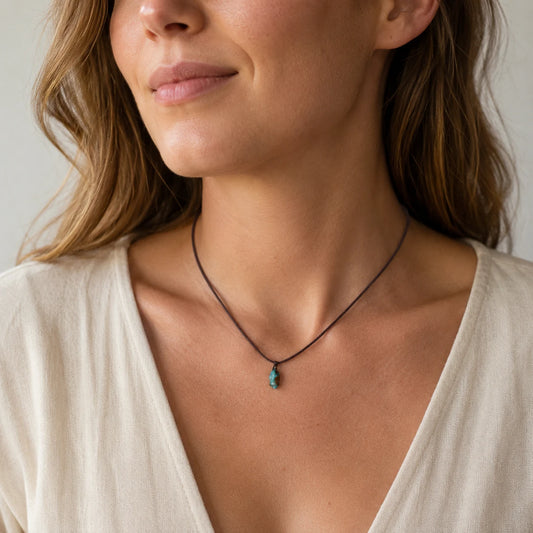
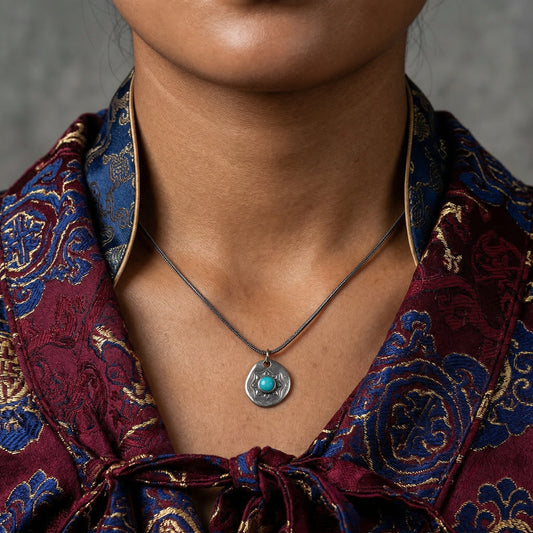
Clarity Frame Necklace — the anchor test, priced at $148.
A rectangular stone in a plain silver frame: geometric enough to sit alone, which makes it a clean way to test Rule 1 — wear only this and see if the outfit already feels finished. It sits naturally on crew-neck knits and just above an open blouse collar, which is exactly why it works as a first anchor for office minimalist dressing.
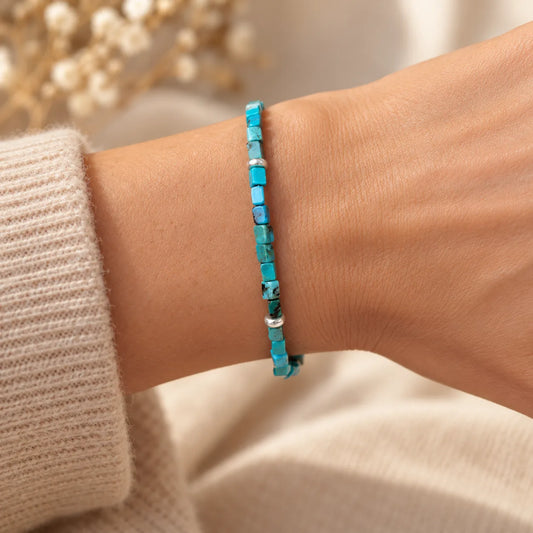
Clarity Bracelet — the zone test, priced at $158.
Cube-cut stones with slim silver spacers give the wrist one structured focal point, and the low, flat profile slips cleanly under a blazer cuff — so Rule 3 survives a full workday, not just the mirror check in the morning.
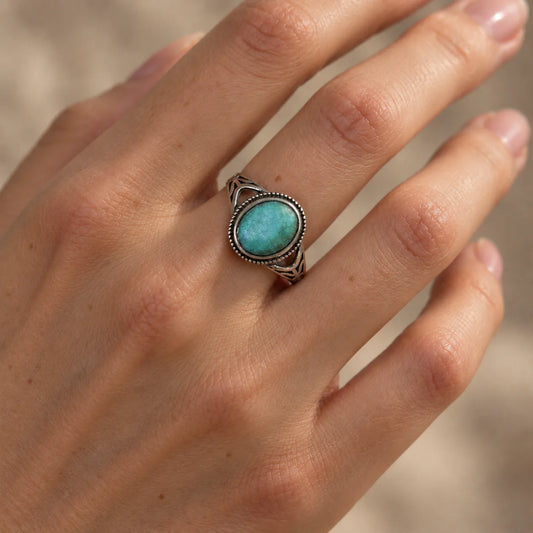
Horizon Ring — the texture test, priced at $128.
A horizontal stone in a signet band puts Rule 5 on your hand: the matrix is the decoration, so the silverwork stays plain. The low-set stone won't knock against a keyboard through a day of typing, while still giving the hand its single visual focal point.

Minimalist Layering: Real Questions, Straight Answers
Q: "I wear mostly black and grey. Won't turquoise look out of place?"
A: The opposite, usually. Neutral outfits are the best background turquoise can ask for — the stone becomes the single color moment instead of competing with a print. Start with one piece in one zone and live with it for a week before adding anything.
Q: "How many pieces is too many for a minimalist look?"
A: Count zones, not pieces. One focal point each at neck, wrist, and hand — three pieces total — still reads as minimal. Two focal pieces fighting inside the same zone is where "minimal" quietly ends.
Q: "Can I mix my existing gold jewelry with silver turquoise pieces?"
A: You can, but it is the hardest version of layering to pull off, and it works best when the mix is clearly deliberate (for example, one gold piece repeated, not scattered). If your goal is an easy everyday system, keeping one metal family per outfit is the lower-effort path.
Q: "Is a stone with heavy black veins still 'minimalist'? It looks busy up close."
A: Busy and textured are different things. Matrix is one object with internal detail — like raw linen or unpolished wood — and minimalist interiors have used exactly that trick for decades. What breaks a minimal look is many competing objects, not one detailed one.
Q: "Can I layer turquoise jewelry with my existing dainty silver pieces?"
A: Yes. As long as you stick to the one-focal-per-zone rule, a thin silver band or tiny silver studs will sit perfectly alongside a turquoise piece. The stone acts as the anchor, and your dainty pieces act as quiet punctuation.
Q: "Will a turquoise piece feel too casual for a work outfit?"
A: Not with clean silver settings and geometric shapes. A framed pendant or slim signet ring reads as polished and intentional in an office environment, especially against neutral blouses and blazers.
Build the Rest of Your Stack Knowledge
This guide covers how to wear the pieces. Before buying them, the material side is worth twenty minutes of reading:
Make sure the stone is real first. Layering rules can't rescue an imitation stone. Read the identification guide.
Know the most common fake. Bright, uniform, cheap blue stones are often dyed howlite — the loudest possible guest in a quiet wardrobe. Read the comparison.
Learn to read matrix patterns. If texture is going to do your decorating, it helps to know spiderweb from mottled. Read the matrix guide.
Plan a small capsule of pieces. Five slots cover every outfit most weeks contain. Read the capsule guide.
A minimalist stack is a small system: one anchor, one color moment, one focal point per zone, one metal family, and stones with enough natural character to carry the rest. Build it slowly — one honest piece at a time — and it will outlast every trend cycle it meets. When you are ready to choose the first piece, shop by the zone you decided to anchor: necklaces for the neckline, bracelets for the wrist, or rings for the hand.