There's a specific kind of morning stress that has nothing to do with what to wear and everything to do with what to wear on top of it. You've picked the blazer. Then you stand at the jewelry tray for four extra minutes, because "professional" and "not boring" feel like they're pulling in opposite directions.
Office jewelry works when it follows six rules: one quiet anchor piece, nothing that makes noise, nothing that catches on keyboards or fabric, one metal family from head to toe, pieces you can put on without thinking, and exactly one moment of personality. Get those six right, and the four-minute stall at the jewelry tray disappears.
Why this is harder than "just wear something simple"
Office dressing has a rule most style guides skip: everything gets tested by a full day, not a mirror check. A necklace that looks perfect at 8am can be a problem by the 2pm meeting if it swings into a laptop camera or catches on a scarf. The six rules below are less about taste and more about what survives eight hours of actual work.
1. Pick One Anchor, Not a Collection
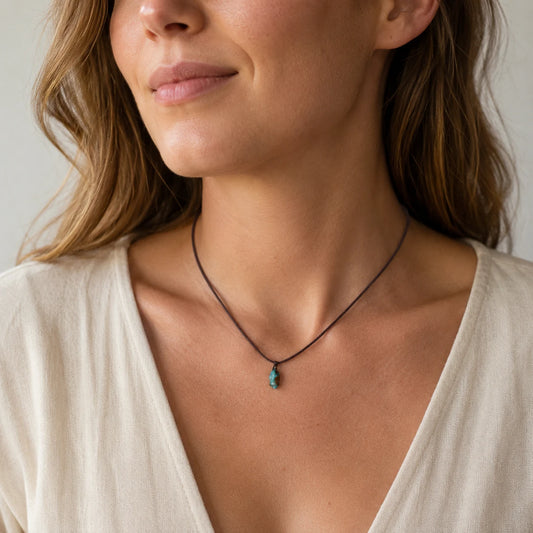
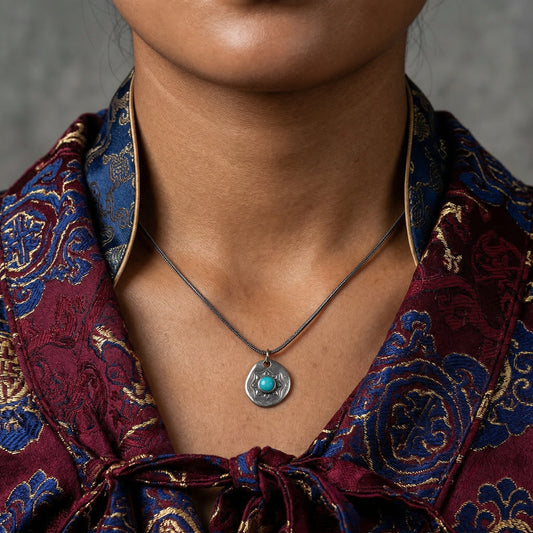
An anchor piece is the one thing your outfit is quietly built around — usually a pendant sitting at the collar, since that's what shows in every video call and every conversation across a desk. Choose one, and let every other piece support it instead of competing with it.
The simplest test: if you removed everything except the anchor, would the outfit still look finished? If yes, everything else is optional polish, not required weight.

2. Silence Is a Feature, Not an Accident
Open-plan offices and conference rooms are quiet enough that a jingling bracelet or a bouncing pendant becomes a small, recurring interruption — the kind of thing people notice without meaning to. Solid stone-and-silver pieces with a fixed setting solve this by default: nothing loose, nothing that chimes against a desk.
If you already own something that jingles, it's not banned — just save it for outside the office, where the same texture reads as personality instead of noise.
3. Nothing That Fights the Keyboard
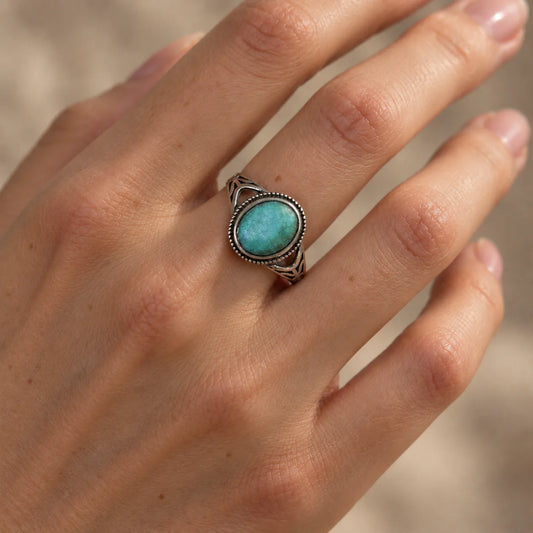
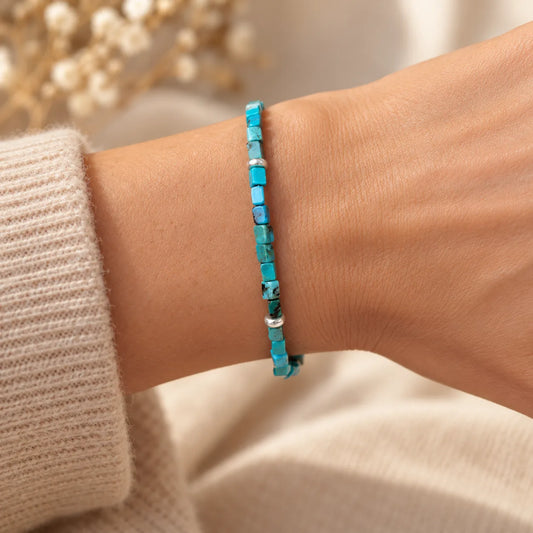
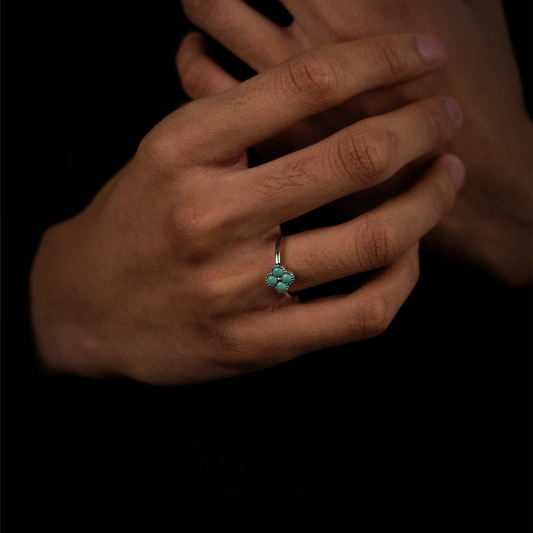
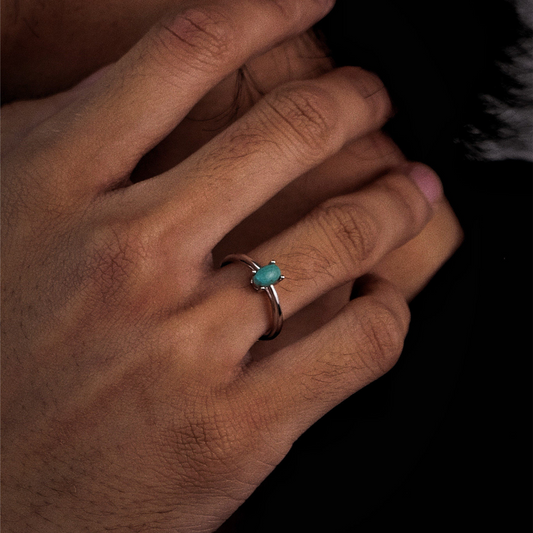
This rule alone eliminates half of "occasion" jewelry from office rotation. Rings with high settings catch on keyboards. Bracelets with dangling elements snag on cuffs. The office-safe version of every jewelry category sits low and close: a flush-set ring, a bracelet that hugs the wrist instead of hanging off it.
It's worth checking your current pieces against a full typing day, not a five-minute try-on — the pieces that fail usually fail by 11am, not in the mirror.

4. Stay in One Metal Family All Day
Mixed metals can be a deliberate style choice elsewhere, but in an office context it reads as less considered — like the outfit was assembled in a hurry. Pick sterling silver or gold-tone and stay there across every visible piece: earrings, pendant, ring, watch, belt buckle if it shows.
This is also the fastest fix if your jewelry tray already feels chaotic: sort by metal first, and half the "does this work" anxiety disappears before you even get to shape or size.

5. Choose Pieces You Put on Without Deciding
The real cost of office jewelry isn't the price tag. It's the decision fatigue of re-choosing every morning. A small, fixed rotation — the same two or three pieces, worn on repeat — reads as more put-together than a large collection worn inconsistently. Consistency itself looks intentional.
If you're building this rotation from scratch, the capsule approach is exactly this idea worked out slot by slot — worth reading if the "what do I even own" stage is where you're stuck.
6. Keep Exactly One Moment of Personality
Rules 1 through 5 are about restraint. Rule 6 is the permission slip: one piece is allowed to say something about you, as long as everything else stays quiet around it. A stone with visible natural texture — rather than a flat, uniform color — does this well, because it reads as considered rather than decorative.
This is where material honesty actually matters for office wear specifically: a cheap, uniformly bright stone reads as costume under fluorescent light in a way it might not outdoors. If you're shopping and unsure what you're looking at, this identification guide is worth five minutes before you buy.

What this looks like by role
| Day type | Wear | Skip |
|---|---|---|
| Back-to-back video calls | Anchor pendant + earrings — both show on camera | Bracelet and ring, invisible on a webcam anyway |
| Heavy typing / spreadsheet day | Flush-set ring only | Any bracelet — save it for a lighter day |
| Client meeting / presentation | Full rotation: anchor, earrings, ring | Anything new or untested — wear what you already trust |
| Casual Friday | Swap the anchor for the one personality piece (Rule 6) | Nothing — this is the day the wildcard earns its slot |
Restraint, not invisibility
None of this is about disappearing. It's about choosing pieces solid enough — real stone, real silver — that they don't need constant adjusting or replacing to still look right by Friday. We'd rather you own three pieces that survive a real workweek than ten that need babying.
A three-piece rotation built for exactly this
Clarity Frame Necklace, priced at $148 — the anchor. A rectangular stone in a plain silver frame sits just above a blouse collar and reads clearly on video calls, which covers Rules 1 and 2 in a single piece.
Axiom Hoops, priced at $88 — small enough to wear under a headset or through a phone call all day without catching, and solid enough to skip the daily in-and-out that loose earring backs require.
Ridge Ring, priced at $108 — a low chevron setting that clears a full keyboard day without catching, so Rule 3 stops being a daily gamble.
Office Jewelry: Real Questions
Q: "Is turquoise too casual for a corporate office?"
A: The stone isn't the issue — the setting is. A clean, geometric silver setting reads as polished regardless of the stone inside it; a chunky, rustic setting is what reads casual. Rules 1, 2, and 4 above do most of the work here.
Q: "Can I wear the same three pieces every day without people noticing?"
A: People notice repetition far less than you'd think — and when they do, a consistent, well-chosen rotation reads as personal style, not a limited wardrobe. The opposite (different jewelry every day, none of it quite right) is what actually draws attention.
Q: "What if my office is more casual — do these rules still apply?"
A: Rules 2 through 5 still hold everywhere jewelry meets a full workday. Rule 6 just gets more room — a casual office can handle a slightly bolder personality piece than a client-facing one.
Q: "I sweat / wash my hands a lot at work — will the silver tarnish fast?"
A: Solid sterling silver handles hand-washing fine; a quick wipe at the end of the day keeps it bright longer. What actually accelerates tarnish is perfume or lotion sprayed directly onto the piece, not water.
Q: "Is it worth spending $100+ on office jewelry instead of a $15 set?"
A: For a rotation you wear five days a week for years, yes — the per-wear cost of one real piece undercuts a drawer of plated sets that fade within a year and need replacing.
Q: "How does this work if I also wear a watch every day?"
A: Treat the watch as part of Rule 4 — match its metal to the rest of your pieces, and let it count as your wrist's one focal point instead of adding a bracelet on top of it. Two pieces competing for the same wrist is the one combination that never reads as intentional.
Build the Rest of the Rotation
Office jewelry is really just capsule jewelry under fluorescent light — the same logic, tested by a harder day. If you haven't built the full rotation yet, start with the capsule guide, or if you already have the basics and want to add a second piece per zone, the layering guide covers that next step. And if a piece that looked office-safe on day one is already looking dull by week three, this guide covers what actually determines whether jewelry holds up to daily wear.
Six rules, three pieces, and the four-minute stall at the jewelry tray is solved for good. When you're ready to build the rotation, the Wisdom collection is where this set lives.